
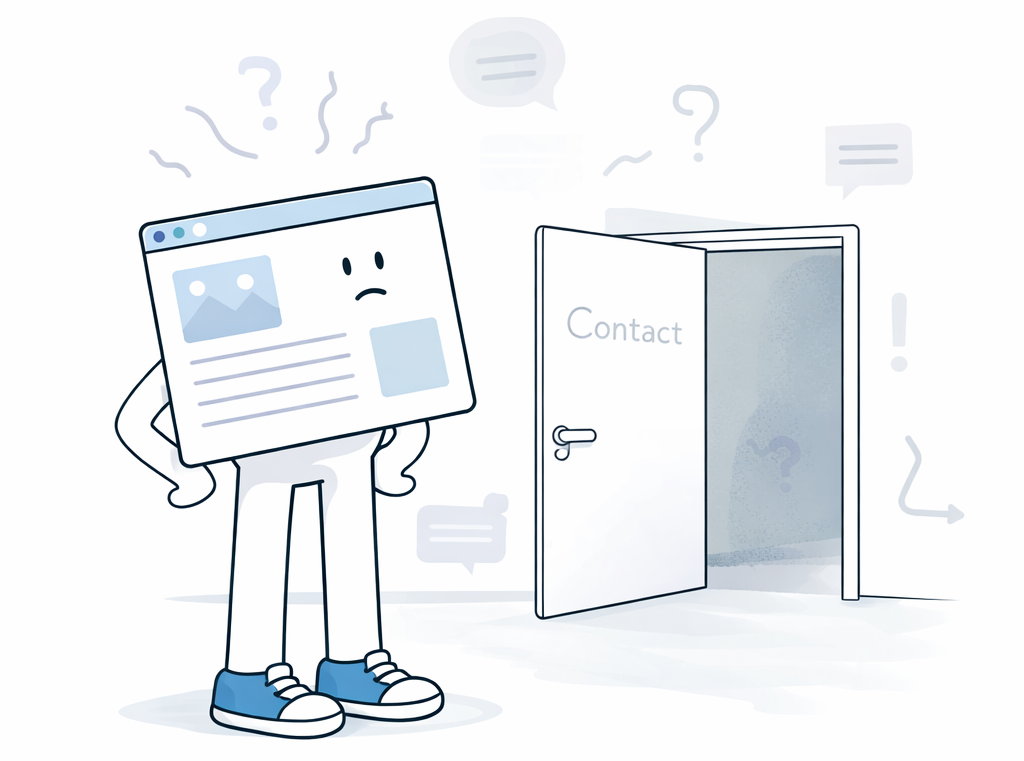
"I have a website, but nothing really happens.”
This is one of the most common things people say after investing time, money, or effort into a site. Very often, the website looks good, feels modern, and may even be relatively new. And still, it doesn’t generate messages, enquiries, or new clients.
The issue is rarely bad luck, and it’s rarely because “the internet doesn’t work anymore.” Most of the time, the problem is simpler and more uncomfortable: the website does not help people understand enough to make a decision.
Why “looking good” means very little to a visitor
What looks good to you is often just visual decoration to someone else. People don’t visit websites to admire design choices. They visit them to quickly answer a few basic questions: who is this, what do they do, and is this right for me?
A website can be modern, clean, and visually polished, yet still say very little. Fonts, colours, and animations cannot replace clarity. If a visitor cannot understand what will happen after contacting you, they will leave, no matter how attractive the site looks.
A website is not judged as an aesthetic object, but as a tool for orientation.
What a client fails to understand when landing on your website
Most websites assume too much prior knowledge. They use vague terms, general promises, or language that sounds impressive but explains nothing concrete. What feels obvious to you is often unclear to someone seeing your business for the first time.
When information is unclear, people do not ask follow-up questions. They don’t send messages asking for clarification. They simply leave. Not because they are uninterested, but because they do not feel confident enough to continue.
A website that doesn’t explain forces visitors to guess. And guessing almost always leads to hesitation.
Why people leave without contacting you
Leaving a website is rarely a conscious decision. Very few people think, “this website is bad.” More often, they feel that something doesn’t fully connect or that what they were looking for wasn’t there.
Maybe it’s unclear what makes your service different. Maybe the first step of working together is vague. Maybe visitors don’t know if you are the right fit for their situation. Any one of these small gaps creates friction.
When friction appears, decisions are postponed. And online, postponing usually means disappearing.
What a website should do to create trust
A website doesn’t need to persuade or impress. It needs to explain. It should provide context, continuity, and reduce uncertainty. Trust is not built through big promises, but through consistent clarity.
When a website speaks plainly, using normal language, people feel they know what to expect. Even if they are not ready to decide, they feel comfortable coming back. And returning is the first real sign of interest.
A website that works does not rush decisions, but it makes them possible.
If your website doesn’t bring clients, it doesn’t mean having a website was a mistake. In most cases, it means the site wasn’t built around how people actually make decisions.
A website doesn’t need to be perfect. It needs to be clear. When people understand what you do and what comes next, contacting you becomes a natural step, not a risky one.